Limits of robots
When a robot is a great idea and when it is just an expensive toy
· 4 min read

The question "is a robot worth it for an event" has no universal answer. A humanoid can be a crowd-puller that people remember for years, or an expensive toy that becomes ordinary after five minutes. The difference is not made by the robot but by whether it fits your goal and your stage.
What a robot at an event actually does
Think of it simply. A humanoid robot at an event is a walking magnet for attention. People stop next to it, take photos, film videos and share them. That is its main job, to bring something into the space that nobody expected there, and in doing so get people talking about your brand.
It is not a waiter or a hostess who can process a hundred people an hour. It is a living attraction that stops a visitor, gives them a reason to come closer and creates a moment they photograph and pass on. In marketing terms it raises the time spent at your stand, your reach on social media and how memorable you are.
When a robot is a great idea
A robot makes sense whenever your goal is attention and differentiation. At a trade fair where thirty similar stands stand side by side, a humanoid draws a crowd that would otherwise walk past. At a product launch it underlines that the brand is modern and not afraid of technology. At a company party or a store opening it creates an experience the guests are still talking about the next day.
- Trade fairs and exhibitions, where you compete for attention with rivals in the same hall
- Product and brand launches that want to appear innovative
- Corporate events, gala evenings and openings, where the experience and the WOW effect matter
- Campaigns where you need content for social media and spontaneous videos from visitors
- School and recruitment events, where the robot draws young people towards technology
When it is just an expensive toy
And now straight talk, because most sellers will not tell you this. A robot is wasted money whenever you expect something from it that it cannot do, or when the setting swallows its effect. If you need to register three hundred people in half an hour, the robot will not manage it and will only get in the way. If you put it in a crowded, noisy space without staging anything around it, it will blend into the crowd.
It is also true that novelty alone wears off. Research from the events environment shows that people turn to robots more for specific practical help than for pure entertainment. So if you have no scenario and the robot just stands around, the effect fades after the first wave of photos. The expensive toy is not the robot itself, but a robot without a plan.
How it really works, without the marketing gloss
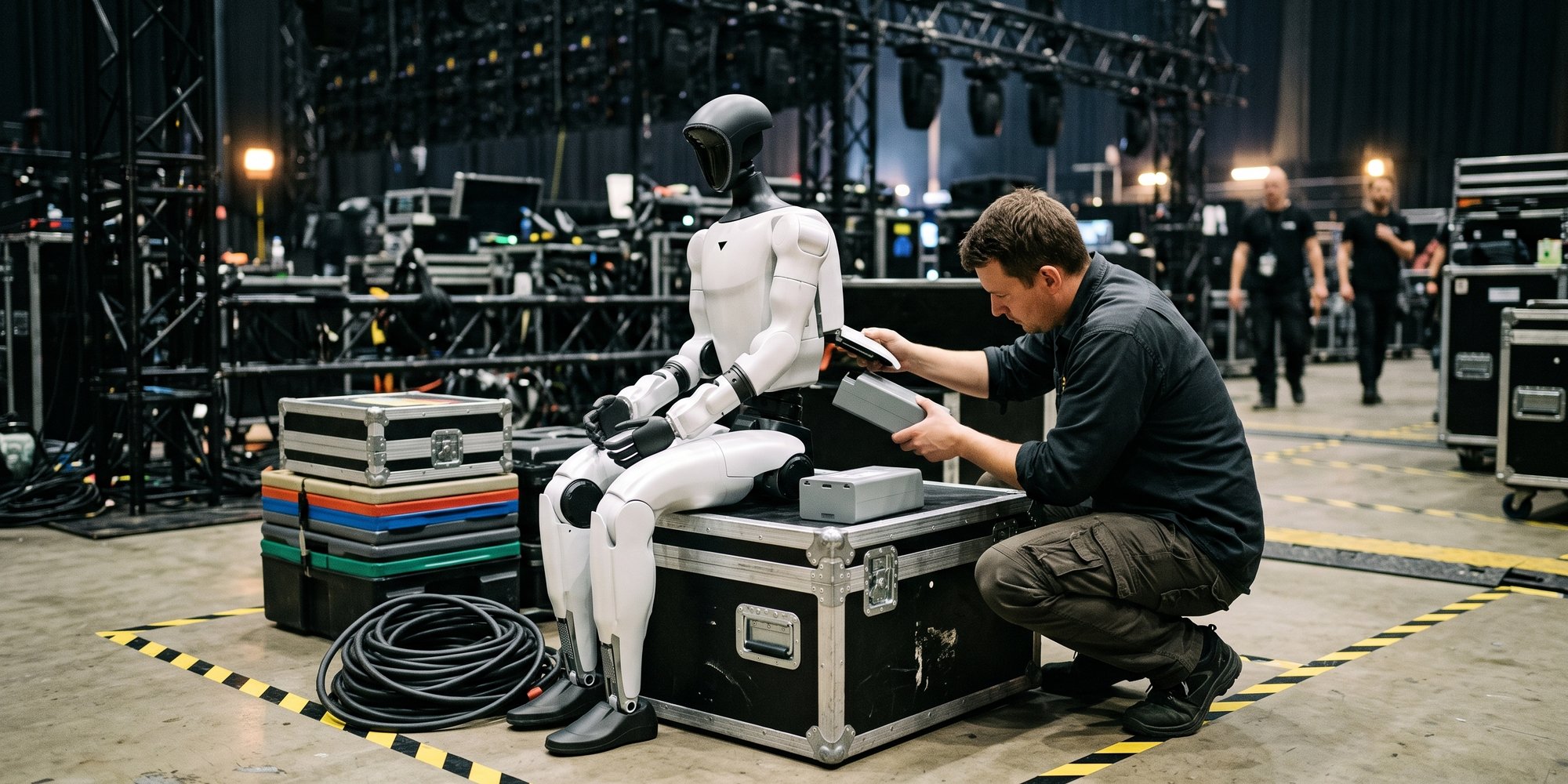
Here are the hard numbers you need to reckon with. A humanoid such as the Unitree G1, which you know from our fleet under the name MONTARI, manages in practice roughly two hours of active operation per battery, not the five or ten hours on the label. The battery is quick-swap, so a longer programme can be covered, but it needs to be planned and you need an operator to do the swap.
Furthermore, these robots are built for indoors. They have no official protection rating against dust and moisture, so rain, mud or a dusty space will put them out of action. The arm carries around one and a half kilograms at full extension, so do not count on it carrying a tray of glasses. And finally, a smooth presentation almost always stands or falls on the operator who guides the robot and reacts to the situation.
Limits and what to watch out for
If you take one thing away from this article, let it be this section. A robot has limits and a fair supplier will tell you about them in advance.
Hidden costs tend to be where you do not expect them. A rental comes with transport, which you should never automatically count as part of the price, a refundable deposit and, for a longer programme, the operator's time. The environment also matters, outdoors, rain and extreme noise are a problem for a humanoid. And watch your expectations, a robot is an attraction and an experience, not a workforce that replaces staff.
- Endurance realistically around two hours per battery, a longer programme requires a plan and an operator
- Indoors only, no rain, mud or very dusty environments
- Arm load capacity of around one and a half kilograms, it is not a waiter
- Transport and the deposit are on top of the rental price, plan for them
- Without a scenario and staging the effect fades quickly after the first photos
A decision framework for a company
Before you decide, ask yourself three questions. First, what is the goal. If it is attention, reach and memorability, a robot is a strong tool. If it is logistics and processing people, look elsewhere. Second, what is the environment. A dry interior with space where the robot can stand out is ideal. A crowded, noisy hall without staging is a risk. Third, do you have a scenario. A robot with a prepared programme and an operator is an experience, a robot without a plan is just a figure in the corner.
If you are not sure which form of rental is worth it for you, take a look at the overview of rental types, where you will find the difference between the event package and rental for development and testing. The operator is part of both formats. It will help you match your budget to what you really expect from the event.
What a company should take from this
A robot at an event is worth it when you want from it exactly what it is good at, meaning attention, experience and content, and when you create the conditions for it. This includes a refundable deposit according to the length, the way it is used and the delivery location. Prices are excluding VAT and transport is not part of the price.
The recommendation is simple. Do not book a robot because it is a robot. Book it when you have a goal it fits and a plan that will make use of its effect. If you are not sure, write to us at info@robotrental.sk, we will go through your event and tell you straight whether it makes sense or whether it would just be an expensive toy.