
Case studies and practice
What can go wrong when deploying a robot at an event
· 4 min read
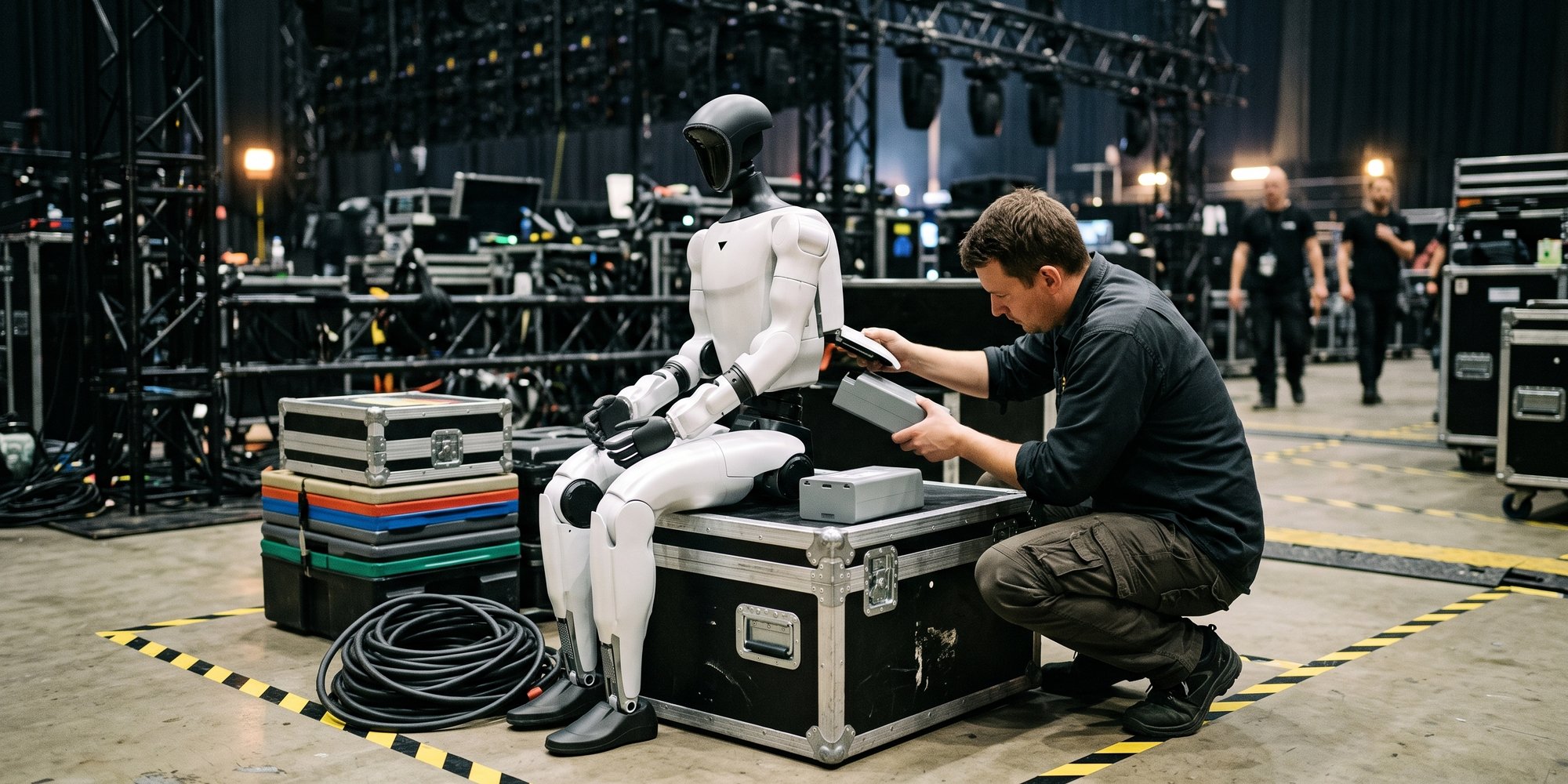
Deploying a robot at an event looks smooth in videos, but reality in a crowded hall is trickier. In this practical breakdown we go through what most often goes wrong, why, and how to prevent it before the guests arrive.
Put simply: why a demo fails
A humanoid robot on stage looks like a toy that just walks and waves. In reality it has to recalculate its balance every second, read its surroundings from sensors and hold a connection to the controls. It is enough for one of these links to drop out and the impressive demo becomes a standing or fallen machine.
Most problems at events do not come from a fault in the robot but from an environment nobody thought about. Weak WiFi, a slippery floor, a flat battery or a crowd that presses in too close. These are things that do not happen in a laboratory but are almost certain in a hall full of people if the company does not prepare for them.
Technically: where the real weak points are
The first weak point is connectivity. Exhibition halls have hundreds of devices connected at once and dense radio traffic, where the latency of ordinary WiFi easily jumps to tens or hundreds of milliseconds. For a robot waiting for the operator's command, the delay shows up as stuttering or a complete freeze in movement.
The second is power. Active operation of a humanoid such as the Unitree G1 lasts roughly two hours, not a whole day as the marketing figures for standby mode promise. Without a rotation of charged batteries the demo simply goes quiet in the second half of the day. The third point is perception of the surroundings, where reflections, smoke from effects or an unexpected obstacle confuse the sensors and the robot prefers to stop.
- Connectivity: a congested radio band and high WiFi latency
- Battery: realistically about two hours of active operation per charge
- Sensors: reflections, smoke, a dark or glossy floor
- Space: a crowd pressing into the robot's safety zone
Specific scenarios we have seen
A typical example is a store opening where the robot welcomes guests at the entrance. It works for an hour, then the pace of the demo slows down because nobody planned for a battery swap and one set is not enough for four hours of intermittent operation. The solution is banal, two or three charged sets and ten-minute breaks between cycles.
The second scenario is a conference where the robot walks between the tables. The floor is polished tiles, the robot feels unsteady on them and slows down. Or a trade fair where the crowd pushes in so close that the robot stops according to its safety settings and refuses to move. Both cases are solved by a good operator and a clearly marked zone, not a stronger machine.
Limits the hype sellers keep quiet about
Let us be honest, a robot is not an entertainer that can handle anything. It does not cope well with a noisy environment with unexpected obstacles without a prepared scenario, it cannot spontaneously improvise with guests outside its programmed actions, and outdoors it is threatened by rain, dust and uneven terrain. Anyone who promises a robot that entertains a crowd on its own for four hours is either lying or has never done it.
Another limit is preparation time. A robot cannot be unpacked five minutes before the event and switched on. It needs calibration for the specific floor, a connection test in the given hall and a rehearsal of the scenario. Anyone who does not allow this time on site is asking for a frozen demo in front of a full room.
Pre-event checklist: what to verify
Most problems can be prevented by simply going through a few points before the date is confirmed. This list will save you the most common embarrassments and help set realistic expectations for the client and for you.
- How many hours the robot really has to work and how many batteries that covers
- What the floor surface is and whether it is level, dry and non-slip
- Whether the event is indoors, or whether rain and wind are a risk outdoors
- Whether we have a dedicated safety zone the crowd will not enter
- Whether there is time on site for calibration and a connection test before the start
- Who the operator is and whether they have rehearsed the scenario in a real hall
Why the operator decides the outcome
The difference between a successful and an embarrassing demo is not the robot model but the person at the controls. An experienced operator walks the hall in advance, finds a spot with a stable signal, adapts the pace of the scenario to the environment and, the moment something goes wrong, switches smoothly to a backup action without the guests noticing. That is exactly why we always offer event rental with an operator.
If you are considering which format suits your event, take a look at our rental types, where it is set out which format suits an event and which suits development or testing. The operator is part of every hire, and it is the operator who keeps the risk of a freeze or a fall under control and can react to it immediately.
What a company should take from this
A robot at an event is a strong crowd-puller that attracts attention and gets talked about even after the event. But it is a live technical system, not a plush mascot you put in a corner. Anyone who approaches it with respect, allows time for preparation and plans for batteries and space gets a smooth and memorable experience.
The recommendation is simple. Do not book a robot for four hours without a plan B. Choose a supplier who asks you about the floor, the signal and the length of operation, because that is a sign they know what can go wrong. We think about these things for you, so that you can focus on your guests.


