Robots in schools and education
A robot for schools: how to show AI live
· 3 min read

Explaining artificial intelligence from a presentation is one thing, showing it live on a humanoid robot is a completely different experience. For schools, a live robot is the strongest tool for turning the abstract concept of AI into something tangible that pupils remember. In this article we look at how such a demonstration works, which school levels it makes sense for, what needs to be prepared and where the real limits are.
Why a live demonstration works better than theory
Pupils and students today hear about artificial intelligence from all sides, but rarely see it standing in front of them in physical form. A humanoid robot removes that distance instantly. When the robot waves, walks across the classroom and reacts to people, the abstract concept of AI turns into a concrete experience.
This effect also has educational value. A live demonstration naturally provokes questions: how does the robot keep its balance, how does it know where the wall is, who is controlling it. It is precisely from these questions that a quality lesson on sensors, programming and the limits of today's robotics can be built.
Which schools and levels it makes sense for
The demonstration can be adapted to the age of the audience. One emphasis suits primary school, another secondary school and another university, where you can already go into technical depth.
For universities and STEM programmes we also offer a separate format that goes deeper into programming and robotics, including work with the EDU version and its SDK.
- Primary schools: emphasis on the experience, motivation towards technology and a simple explanation of how the robot perceives the world.
- Secondary schools: a link to the curriculum on programming, sensors and the ethics of artificial intelligence.
- Grammar and vocational schools: a demonstration of career paths in robotics and AI.
- Universities and STEM: technical depth, demonstration of the SDK, teleoperation and development possibilities.
How a robot demonstration in a school works
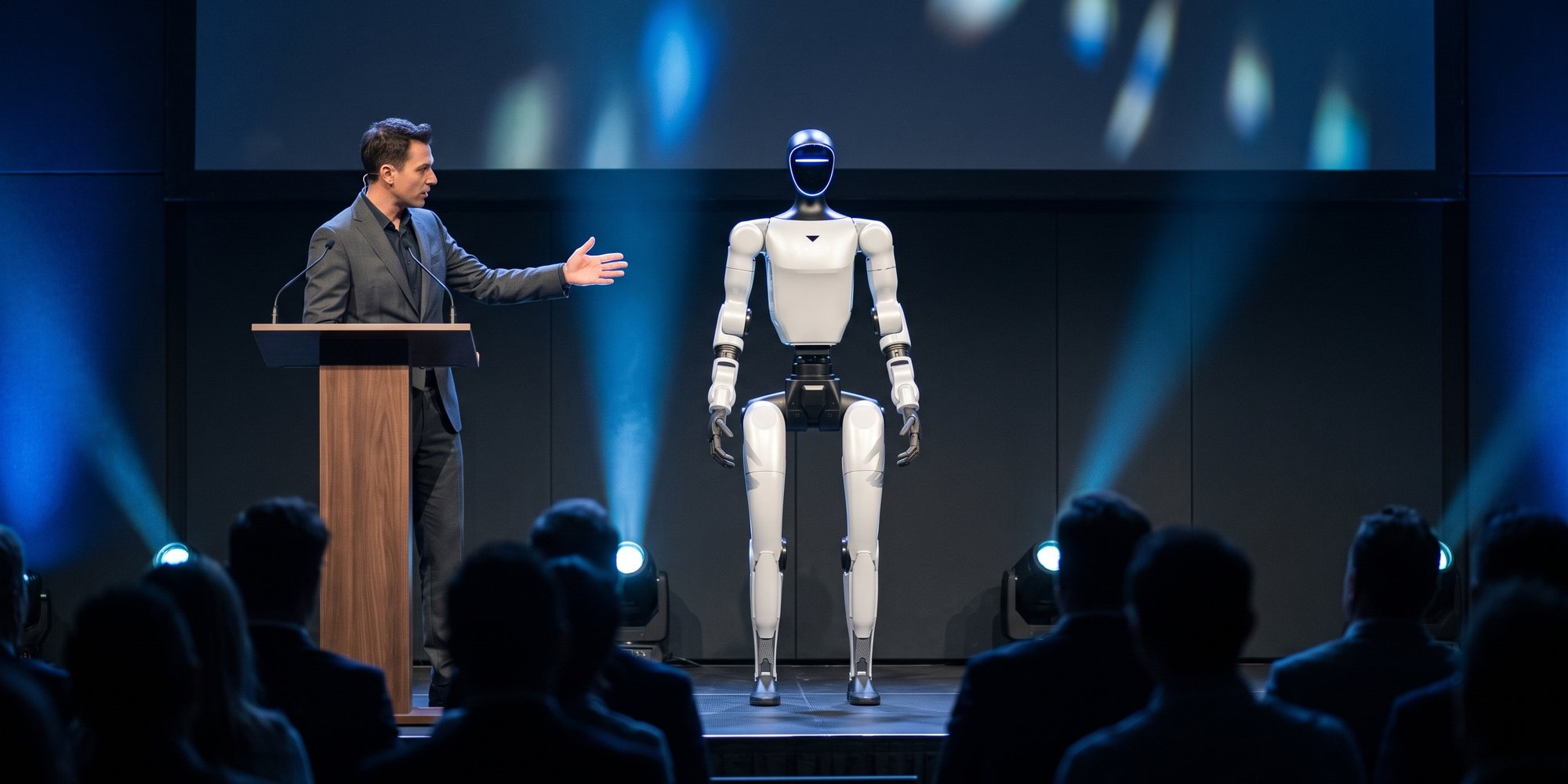
A good school demonstration has a clear structure, it is not just a display of movements. First the robot captures attention with its entrance and a few movements, then comes the explanation and interaction with the audience. Throughout the event the robot is controlled and supervised by an operator, which at the same time serves as a vivid demonstration of teleoperation.
In practice the Unitree G1 robot works best, which we offer as the MONTARI model, or the EDU version as the NOVA model. The G1 is around 1.32 m tall and weighs approximately 35 kg, so it comes across as a smaller person, which feels natural to the audience and is not intimidating.
- Introduction and wow moment: the robot's entrance and a few movements that win the class's attention.
- Explanation: how the robot perceives space through sensors and 3D LiDAR and how the operator controls it.
- Interaction: room for pupils' questions and a demonstration of specific movements on request.
- Conclusion: a link to the curriculum, career paths and a discussion of the limits of today's AI.
What the school prepares in advance
For the demonstration to run smoothly, a few basic things need to be arranged. The robot needs a flat and safe space with enough room around it, separated from close contact with the crowd. A gym, an assembly hall or a larger classroom with a cleared floor is suitable.
Timing matters too. The robot has limited battery life, so the programme is planned realistically and, with several groups, breaks are factored in. It is also a good idea to agree in advance on the number of pupils in one group so that everyone can see and hear.
- A flat and safe space with room around the robot and a cleared floor.
- An electrical socket within reach for charging between sessions.
- Realistic timing and division of pupils into groups.
- A contact person from the school for coordination on site.
Limits to allow for
To set expectations correctly, you need to know the boundaries. A humanoid robot is not an all-knowing assistant that could teach a lesson on its own. It is a demonstration and motivation tool, controlled by an operator, which works best within a prepared scenario.
Battery life is in the order of hours, so all-day marathons for the whole school are planned with breaks and battery swaps. Handling objects is limited and is best done by the EDU version with its dexterous hands. And since it is a moving device weighing around 35 kg, it requires a dedicated space and a safe distance to be maintained.
These limits are not an obstacle, on the contrary, they are an excellent topic for the lesson. An honest explanation of what the robot can and cannot yet do is often more valuable to pupils than a perfect performance.
Recommendation: how to book a robot for your school
If you want to show pupils artificial intelligence live, a humanoid robot is the strongest tool on the market. For most schools the ideal choice is the MONTARI model (Unitree G1), for technically oriented demonstrations and universities the NOVA model (G1 EDU) with full access to the SDK.
A multi-day rental lowers the daily rate, and event formats are a complete turnkey service. The operator is always part of the hire, not an optional item. The price depends on the robot model, the length of the rental and the staging, always plus a refundable deposit. Transport is never part of the price and is handled individually according to the school's location. We are happy to prepare a programme tailored to the pupils' age and a no-obligation calculation within 24 hours, just write to info@robotrental.sk.