Humanoid robots in practice
Unitree G1: what it can do, what it suits and where its limits are
· 3 min read

The Unitree G1 is one of the best-known humanoid robots of today and at the same time the most common choice for events, presentations and education. Yet a lot of exaggerated expectations circulate around it. In this article we look at what the G1 can really do based on the manufacturer's confirmed specifications, which deployments suit it best and where its objective limits lie that you need to allow for when planning an event.
What the Unitree G1 is and why everyone is talking about it
The Unitree G1 is a compact humanoid robot from the Chinese manufacturer Unitree Robotics. It came to market as one of the first more affordable humanoids, which made it the de facto reference model for demonstrations, research and commercial activations. That is exactly why you will find it in our offer as the models MONTARI (G1) and NOVA (G1 EDU).
Its popularity does not rest on price alone. The G1 can stand, walk, gesture, rotate its torso and perform fluid movements that look surprisingly natural to spectators. Combined with compact dimensions and relatively low weight, it is a robot that can realistically be deployed indoors without demanding infrastructure.
Real specifications of the Unitree G1
With humanoid robots it is important to stick to the manufacturer's confirmed figures, not marketing superlatives. In its standard configuration the Unitree G1 has the following parameters, which directly determine what you can do with it in practice.
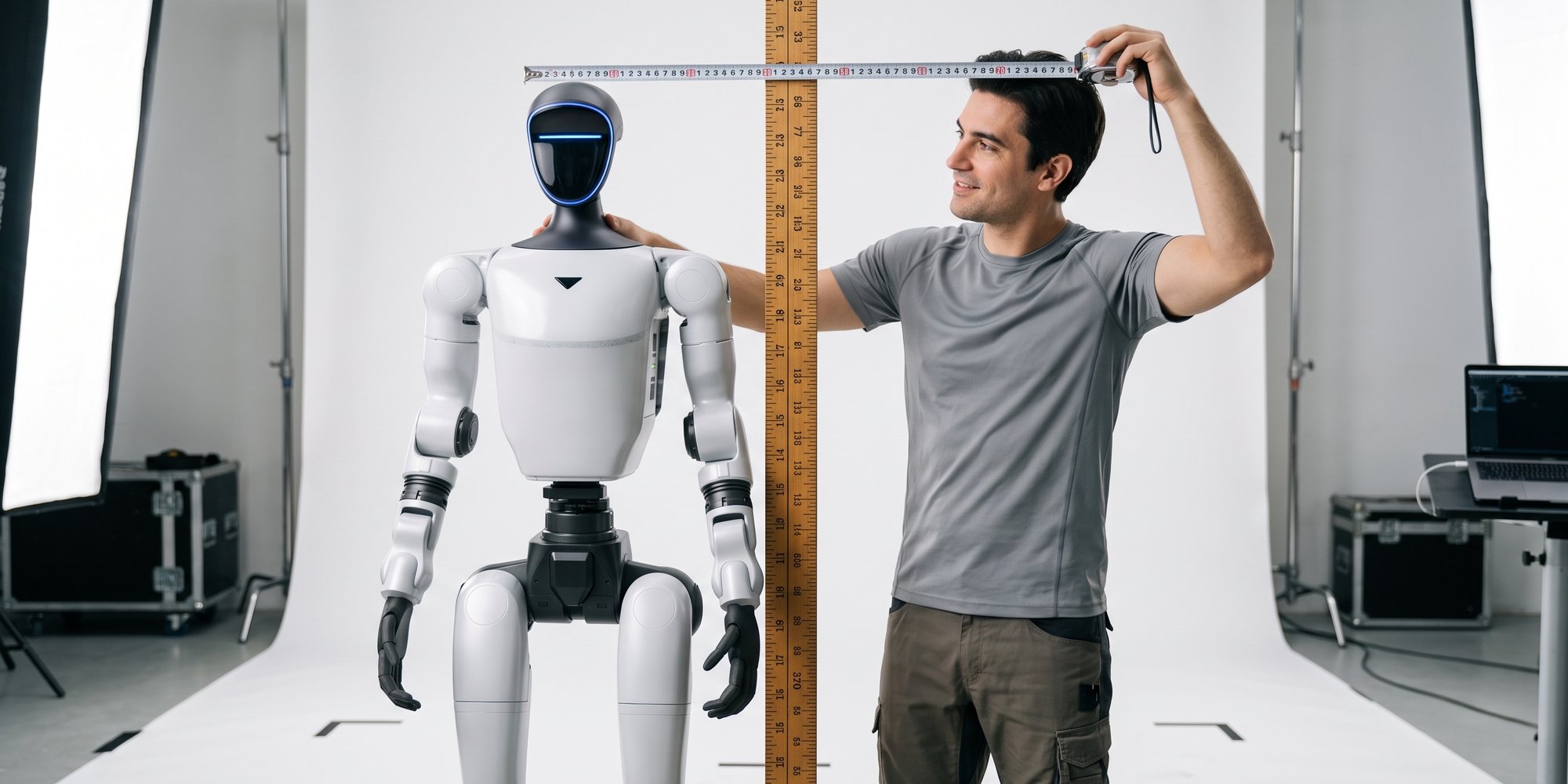
- Height of approximately 1.32 m standing, which corresponds to a smaller adult or a child.
- Weight of around 35 kg including the battery, so it is portable and folds into compact dimensions.
- 23 degrees of freedom in the basic version, up to 43 degrees of freedom in the G1 EDU version including dexterous hands.
- A battery with a capacity of 9000 mAh and a real-world life of approximately 2 hours of operation.
- Walking speed of up to 2 m/s and support for 3D LiDAR for spatial perception.
- In the EDU version an integrated NVIDIA Jetson Orin computing module and full access to the SDK.
What the Unitree G1 can really do
The G1's greatest strength is its movement. Thanks to its large number of joints and quality balance control, it handles dynamic walking, squats, gestures and choreographies that come across to the audience as a wow moment. That is exactly what makes the G1 an ideal attraction for events where the goal is to capture attention and create content worth sharing.
The EDU version adds dexterous hands and the computing power of the Jetson Orin, which opens the door to handling objects, advanced perception of the surroundings and the integration of AI models. That is why development teams choose this particular configuration for research and prototyping.
The robot can be controlled by teleoperation (remotely by an operator) as well as by triggering pre-prepared sequences. The lower body has a built-in locomotion controller that takes care of balance, so the operator can concentrate on the upper body and the interaction.
Which deployments the G1 suits best
The G1 is an all-rounder that excels wherever the primary goal is experience and attention. It is not a work machine for physical labour, but an excellent communicator for a brand.
- Trade fairs and stands, where it attracts visitors and increases the time spent at the exhibit.
- Product launches and PR events, where it creates a strong visual moment for the media and social networks.
- Conferences and corporate events as a host of attention or an opening element of the programme.
- Schools and universities, where it serves as a live demonstration of robotics and AI.
- Development projects on the EDU version, where custom algorithms and AI integrations are tested.
Where the Unitree G1 has its limits
For an event to succeed, you also need to know the boundaries. The G1 is a top humanoid in its class, but it is not a sci-fi android. The biggest practical limitation is battery life. In real operation allow for roughly two hours, which is why battery swaps or breaks are planned for all-day events.
The robot is not a fully autonomous humanoid that could independently hold long conversations and walk through a crowd. For reliable and safe running it needs an operator who controls it and watches over the situation. Handling objects is possible mainly in the EDU version with dexterous hands, and even there it has its limits in precision and strength.
Given its height of around 1.32 m and weight of 35 kg, it is a moving device that requires a dedicated and safe space away from close contact with the crowd. It is not a machine for heavy physical work or for deployment outdoors in bad weather.
Recommendation: when to go for the G1
If your goal is to create a strong experience, draw attention at a stand or show the technological maturity of your brand, the Unitree G1 is an excellent choice with the best effect-to-cost ratio in its class. For events we offer it as the MONTARI model, for development and education with dexterous hands and more computing power as the NOVA model (G1 EDU).
For interactive movement attractions, in turn, there is the robot dog ORYX (Unitree Go2).
The rental price depends on the robot model, the length of the rental and the staging, an event is a complete turnkey service with an operator and for a multi-day rental the daily rate goes down, always plus a refundable deposit. Transport is never part of the price and is handled individually. We are happy to propose a specific configuration and a tailored, no-obligation calculation within 24 hours, just write to info@robotrental.sk.