
Limits of robots
The biggest limits of humanoid robots in 2026
· 4 min read
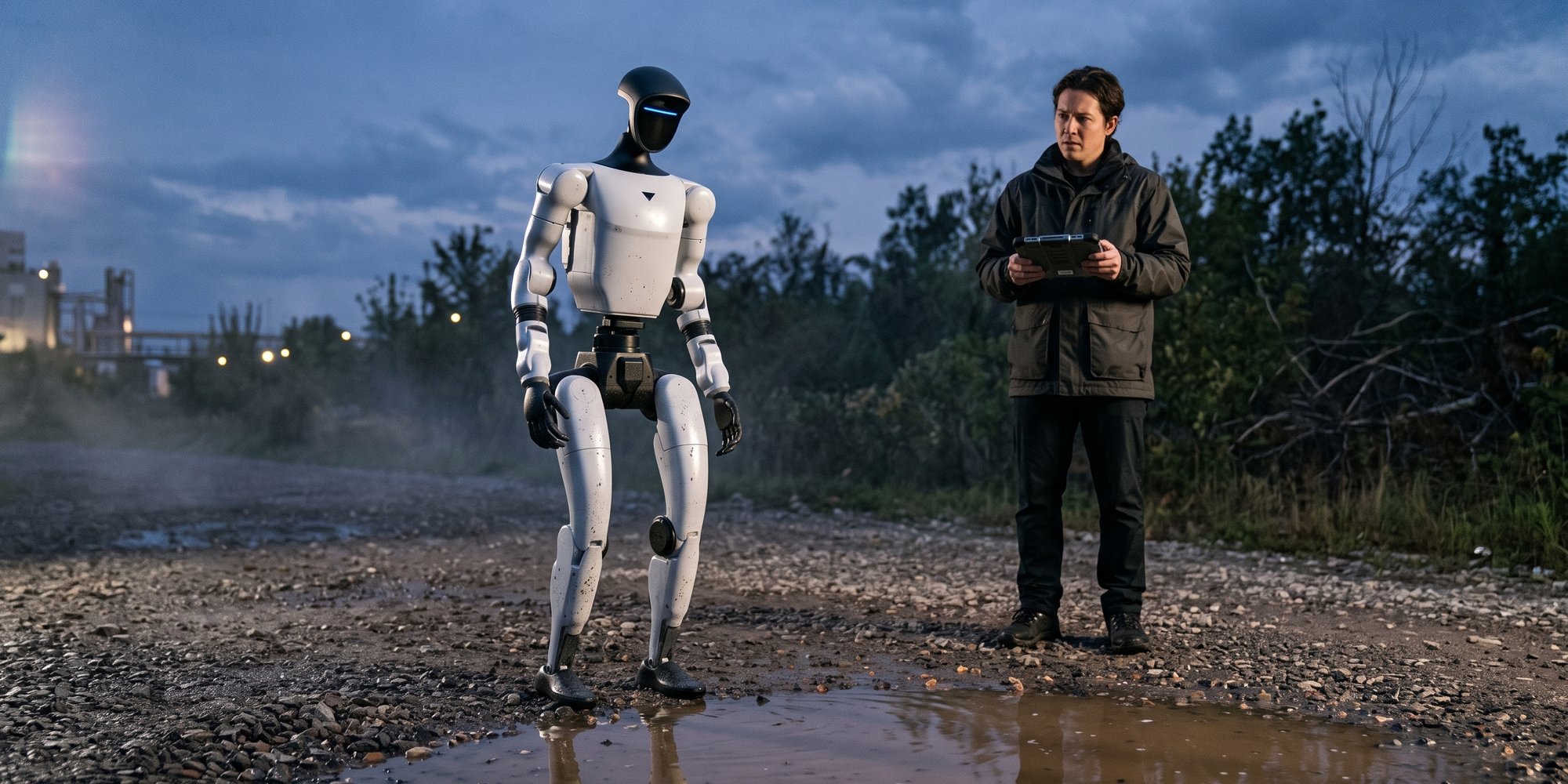
In videos humanoid robots look like the finished future, but reality has its limits. This article honestly examines the biggest limits of humanoid robots in 2026, so that you know what to realistically expect from them at an event and what you had better not.
What a humanoid robot is today and why it has limits
A humanoid robot is a machine with a human-like body that can walk, gesture, turn its head and communicate. In practice these are platforms such as the Unitree G1 (our MONTARI and NOVA models) or the four-legged Unitree Go2 (the ORYX model). They look futuristic, but they are still young technologies with clear boundaries.
The limits do not come from cheap construction but from physics and the state of development. The robot has to keep its balance, power dozens of motors, process images from cameras and look fluid at the same time. Each of these things has its price. That is exactly why it is important to know the reality, not the marketing video.
You also need to be aware of the difference between a laboratory demo and a live event. In the video the robot has ideal light, a smooth floor and ten attempts for one shot. At an event it has one attempt, a crowd around it and unpredictable conditions. Experts and serious manufacturers admit that the gap between a demo and real deployment is still wide, and this is exactly why it makes sense to approach robots soberly.
Battery life is the biggest limitation
The hardest limit of 2026 is energy. Most of today's humanoids last approximately two hours in active operation, and with more demanding movements and manipulation this can drop to under an hour. Both the Unitree G1 and H1 models sit at around two hours of real endurance, after which they need charging.
For an event this means one simple thing: the robot does not run for eight hours straight. Work is done in blocks with breaks for charging or swapping the battery. A good rental takes this into account and plans the performances so that the robot is active exactly when it has the greatest impact.
- Active operation of approximately 2 hours, less with intensive movement
- Charging takes around an hour to an hour and a half
- The solution is a schedule of blocks, not a continuous show
Fine motor skills and handling objects
The robot can handle walking, gestures, a handshake or a simple grip. What it cannot yet handle reliably is human-level fine motor skills, meaning precise work with fragile objects, opening packaging, writing or complex assembly. Experts agree that this area is catching up with human dexterity only slowly.
In practice this means the robot is excellent for representation, interaction and a wow moment, but it is not a waiter or an assembly worker. If someone promises that the robot will carry glasses of champagne among the guests at an event, that is more of a risk than a realistic plan.
This limit is not a temporary bug that someone will fix in a few months. Reliably grasping various objects in a changing environment is one of the hardest tasks in all of robotics and progress is slow. When planning an event, therefore, build on what the robot can handle reliably today, not on what it might theoretically be able to do one day.
Autonomy and the need for an operator
A humanoid robot is not a fully independent being that does what it wants at an event. In a public environment full of people, lights and noise it needs human supervision. The operator controls the movement, triggers learnt scenes and can switch to manual mode at any moment, which is the basic safety measure.
This approach, with a human in the control loop, is the standard today, and it is not a weakness but a responsible way of deploying. The robot appears independent towards the audience, but behind the scenes it is guarded by an experienced operator who prevents unpleasant surprises.
Environment, navigation and outdoor conditions
Robots work best in a predictable environment. A smooth, level floor, good lighting and enough space are ideal. Demanding terrain, stairs, rain, dust or strong sun significantly reduce reliability. Outdoor deployment is therefore always assessed individually.
WiFi quality and signal interference also play a role, because control and some functions run over the network. A congested band at a trade fair can cause problems, which is why a separate connection is prepared for the robot.
- Ideal: a level, dry floor, good light, enough space
- Problem: stairs, uneven terrain, rain, dust, strong sun
- Risk: congested or unstable WiFi in the hall
What a company should take from this
A humanoid robot in 2026 is a top-class tool for attention, experience and content that gets shared. It is not a universal worker or a replacement for staff. If you approach it with realistic expectations, you get a strong marketing and PR effect without disappointment.
The practical rule is: plan the robot for short, striking moments, plan for an operator and for charging breaks, and leave the preparation to professionals. When choosing a suitable model and type of deployment, the overview of our rental types at /typy-prenajmov will help you see what makes sense for your event.
The price depends on the robot model, type of rental, length of deployment, use and location, plus a refundable deposit, with transport arranged separately. If you want advice on a specific scenario and a quote on request, write to us at info@robotrental.sk.


