Limits of robots
Why a humanoid robot needs an operator
· 3 min read

Marketing videos create the impression that a humanoid robot is an independent being that looks after itself at an event. The reality of 2026 is more sober: behind almost every impressive performance is a person who controls or supervises the robot. The operator is neither a luxury nor a failing of the technology, but a necessary part of safe and smooth operation. In this article we explain what the operator really does, why today's autonomy cannot replace them and what it means for your event.
What a robot operator does
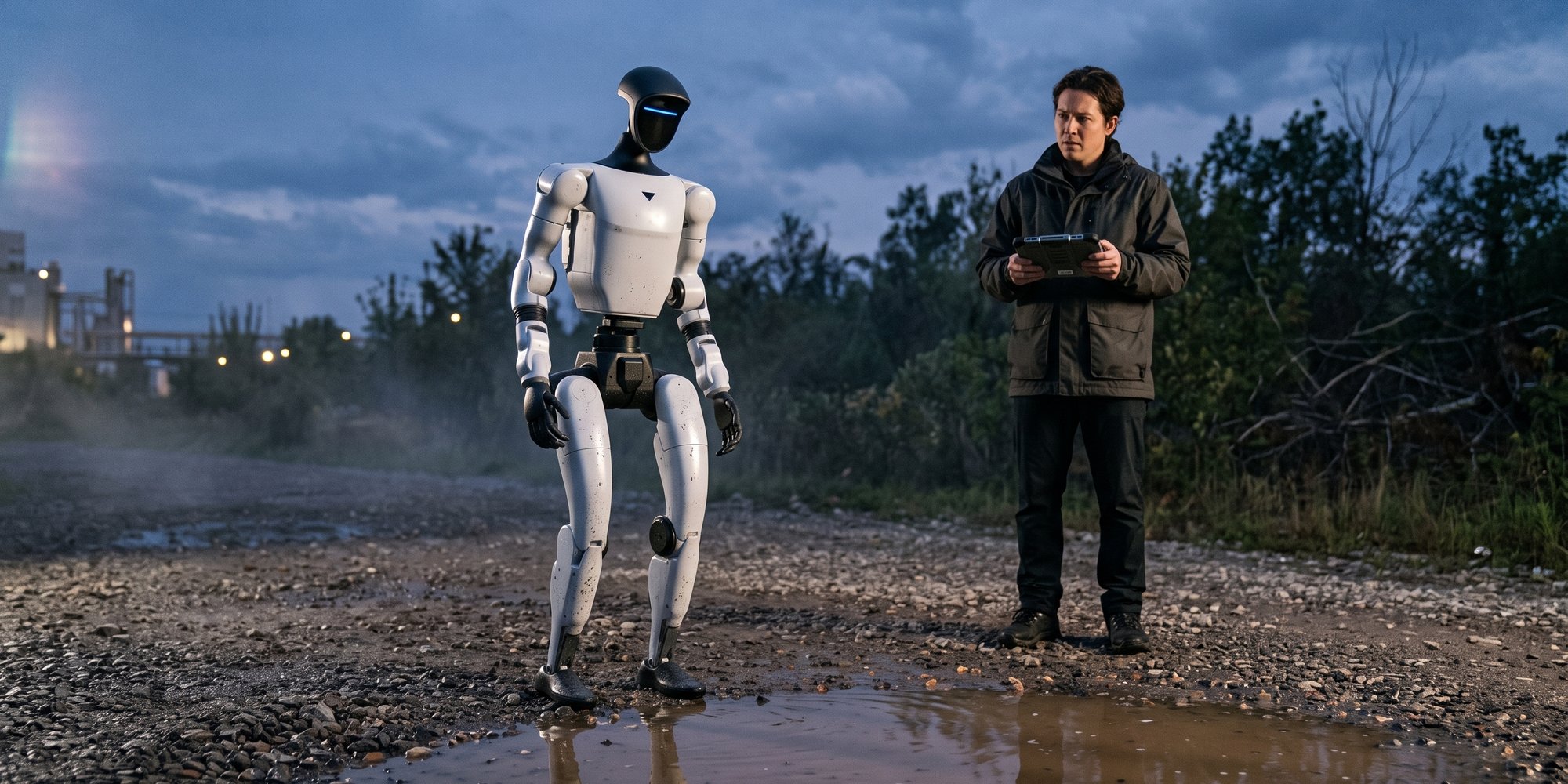
The operator is the person who controls, monitors and corrects the robot during the event. In practice this ranges from direct control (teleoperation) through triggering prepared scenarios to supervision, when the robot runs semi-automatically and the operator intervenes only when needed.
Their job is not just "pressing buttons". They read the situation, react to the crowd, adjust the pace of the programme, deal with unexpected moments and above all guard the safety of people and equipment. It is this cognitive flexibility of a human combined with the physical capabilities of the robot that makes a reliable performance.
Why the robot cannot manage on its own: the limits of autonomy in 2026
The key reason is the state of the technology. Full autonomy would mean that the robot can cope on its own in a completely unfamiliar and changing situation. For physical tasks we are still years away from that.
Many demonstrations that look like an "autonomous robot" actually rely on teleoperation or on a pre-prepared scenario. It is a legitimate approach, but it is not proof of independence.
- The robot cannot reliably handle manipulation of unknown objects.
- It cannot recover with certainty from a fall or an unexpected disturbance.
- It struggles in a truly unstructured, chaotic environment (and an event is exactly that).
- It cannot handle multi-step tasks requiring judgement without human intervention.
Teleoperation: when a person controls the robot remotely
Teleoperation means that a person controls the robot remotely or from nearby, often with the support of cameras and special controllers. Manufacturers such as Unitree have developed systems for controlling humanoids (including the G1 and H1) via XR devices, which shows that remote control is today a fully-fledged part of deployment, not an emergency solution.
For an event this has a practical advantage: the operator can immediately direct the robot, stop it or adapt its behaviour to what is happening in front of the audience. It combines the certainty of choreography with the ability to react live.
That is exactly why the operator is usually included in the price of a rental service. Without them you would have expensive hardware with no guarantee that it will do its job reliably and safely at the event.
Safety: the main reason a human must not be missing
A humanoid robot has dozens of joints, actuators and sensors, and each of them is a potential point of failure. At an event it moves among people, often in close proximity, which places high demands on safety.
The operator is the last safeguard. They monitor the surroundings, keep a safe distance from the crowd, stop the robot immediately in case of risk and make sure the movements do not endanger anyone. No current autonomous decision-making system can replace this at a public event with one hundred percent certainty.
Safety is therefore not a formality but the first reason why a serious provider never leaves out the operator.
What it means for your event and budget
The presence of an operator has practical and financial consequences that need to be taken into account when planning.
- The operator is part of the rental price, not an extra item that can simply be crossed out.
- Be suspicious of offers where you are really paying only for the loan of a machine and carry the risk yourself.
- Bear in mind that the operator needs space for preparation and calibration before the event.
- A prepared scenario plus an operator live is more reliable than relying on pure autonomy.
- Transport of the operator and the robot is arranged separately according to the location and is not part of the rental price.
Recommendation for the client
Do not see the operator as a necessary evil but as a guarantee that your investment in the robot will turn out well. It is the person behind the robot who turns impressive hardware into a smooth and safe experience for your guests.
When choosing a provider, ask who will control the robot, what experience they have and whether they are included in the price. If someone promises you a fully autonomous robot without staff for a fraction of the price, that is a warning sign.
Event rental with us is a complete turnkey service with an operator, and rental for development and testing likewise takes place with an operator. The price depends on the robot model, the length of the rental and the scope of the staging, and for a multi-day deployment the daily rate goes down. Transport and the refundable deposit are arranged separately. We will gladly prepare a no-obligation tailored quote within 24 hours at info@robotrental.sk, and you can find an overview of the formats at /typy-prenajmov.